
Bioremediation
Bioremediation is a sustainable waste management technique that employs biological agents — typically bacteria — to metabolise and degrade environmental contaminants into non-toxic substances like water and carbon dioxide.
Essentially, the process "copies nature" by using microbes that have evolved over millions of years to break down organic pollutants. In industrial applications, such as those used by Bemical, this natural process is "boosted" by introducing scientifically formulated products containing billions of CFU/g (Colony Forming Units) to degrade toxins in record time.
Core Principles of the Process
The microbes used in bioremediation treat pollutants as a substrate or nutrient source. Depending on the environment and the specific waste stream, the process generally follows one of two pathways:
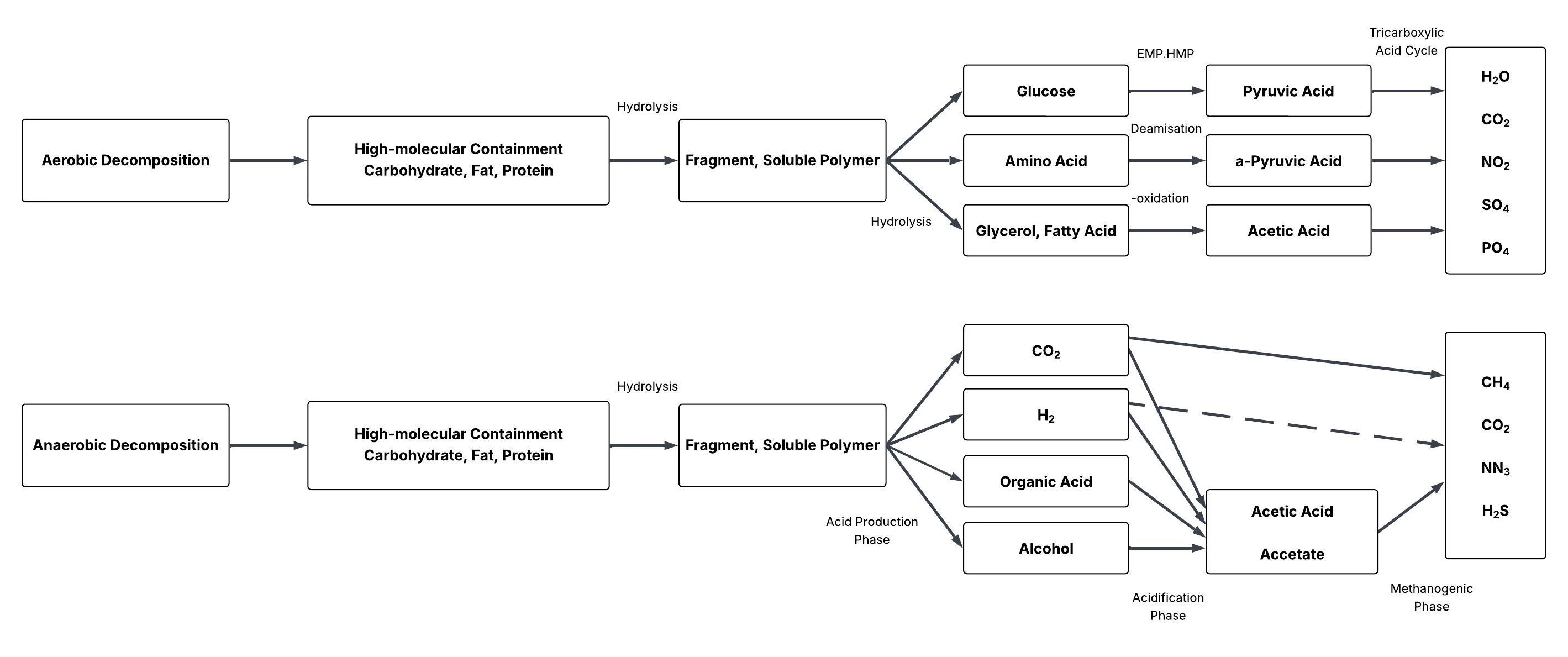
- Aerobic Decomposition: Occurs in the presence of oxygen, resulting in end products such as H2O, CO2, and various sulphates or phosphates.
- Anaerobic Decomposition: Occurs in environments lacking oxygen, breaking contaminants down into substances like methane (CH4), hydrogen sulphide (H2S), and carbon dioxide (CO2) .
Methods of Application
Bioremediation is highly versatile and can be applied in two primary ways depending on site conditions:
- In-Situ: The treatment happens directly at the site of contamination (e.g., treating groundwater or soil without moving it).
- Ex-Situ: Contaminated material is removed from its original location (such as soil excavated into bio-piles) to be treated in a controlled environment.
This method is particularly effective for treating hydrocarbons (petroleum, diesel, oils), sewage, and fats, oils, and grease (FOG), often providing a "Zero Waste to Landfill" alternative to traditional disposal.
The Science of Restoration: How Bioremediation Works
Bioremediation is the metabolic degradation of pollutants by biological agents, primarily bacteria, which use the contaminants as a substrate or nutrient source. At Bemical, we "copy nature" by using these organic processes but introduce significantly more power — billions of Colony Forming Units (CFU/g) — to handle high levels of contamination that nature cannot manage alone.
1. The Metabolic Pathways
The breakdown of high-molecular contaminants like carbohydrates, fats, and proteins occurs through two main routes depending on the availability of oxygen.
Aerobic Decomposition (With Oxygen)
This is the preferred route for surface spills and aerated water. The process involves:
- Hydrolysis: Breaking down complex contaminants into fragments and soluble polymers.
- Conversion: Microbes further process these into glucose, amino acids, and fatty acids.
- The Final Cycle: Through the Tricarboxylic Acid Cycle, pollutants are rendered into harmless H2O and CO2.
Anaerobic Decomposition (Without Oxygen)
Used in deep soil or closed systems where free oxygen is unavailable.
- Contaminants enter an acidification phase, producing organic acids and alcohols.
- The final methanogenic phase converts these into methane (CH4), carbon dioxide (CO2), and hydrogen sulphide (H2S).
2. Factors for Success
For our bacteria to perform at record speeds, we manage the following environmental parameters on-site:
| Factor | Requirement for Optimal Performance |
|---|---|
| Moisture | Essential for microbial mobility and diffusion. Optimal levels are between 15% to 30%, with a recommended objective of 25%. |
| pH Level | Effective range for Soilbac is between 5 and 9.5. Most bacteria grow best at a neutral pH, with an optimal range for our products between 7 and 9.5. |
| Temperature | Affects the rate of cellular metabolism. Active between 5°C and 65°C. While activity decreases below 5°C, the process remains effective as temperatures increase. |
| Nutrients | Required to support biological activity. Soilbac is formulated with a balanced addition of nutrients to enable immediate cell synthesis and high performance wherever used. |
| Soil Type | Influences permeability and the movement of air and water. While gravel or sand may require moisture recirculation, Soilbac ensures effective dispersion across various mediums. |
3. Proven Speed and Efficacy
While traditional methods can take months, Bemical’s "Secret Sauce" formulations like Soilbac and Green Lock achieve total reduction in under 4 weeks.
In controlled trials at the University of Pretoria, our custom blends showed significantly higher optical density (biomass growth) compared to standard individual strains, ensuring a faster, more reliable clean-up.
Solidification & Stabilisation (S/S)
Permanent Solutions for Hazardous Waste
Where bioremediation is the answer for organic pollutants, S/S is the internationally recognised gold standard for treating the balance of hazardous waste streams. Our process physically binds and chemically reacts with contaminants to reduce their mobility, ensuring they no longer pose a risk to the surrounding environment.
Why Choose Bemical Solidification & Stabilisation?
- On-Site Treatment: We eliminate the high costs and risks associated with transporting hazardous materials by treating waste directly at your facility.
- Zero Waste to Landfill: By converting waste into a non-hazardous end product, we help you bypass rising landfill costs and meet strict environmental legislation.
- Material Reuse: Our treated end product is engineered to meet specific strength requirements, allowing it to be reused as backfill or sub-base for construction.
- Rapid Curing: Our specialised reagents allow for a curing time of just 4 days, and unlike traditional methods, our process is not influenced by weather conditions.
Solidification & Stabilisation Service Capabilities & Performance
The following table outlines the technical efficiency and processing rates of our S/S service:
Metric | Bemical Performance Standards |
|---|---|
Contaminants Treated | Heavy metals (Lead, Chromium, Nickel, etc.), Asbestos, Cyanide, PGM Tailings, and MGPW. |
Processing Rate | Scalable up to 300m³ per day (Excavator suite) or 100-200 tonnes per hour (Pugmill suite). |
Curing Time | Standard 4-day curing period; unaffected by rain or ambient humidity. |
End-Product Strength | Engineered to meet specific targets (e.g., >1mPa unconfined compressive strength). |
Verification | Leachability tests to confirm non-hazardous status and ensure safety for reuse. |
From Waste to Engineering Fill
Bemical has a proven track record in complex S/S projects, including:
- Property Regeneration: Treating 28,000 tonnes of heavy-metal contaminated soil in 6 weeks.
- Railway Sidings: Managing 15,000 m3 of soil contaminated with diesel and heavy metals, saving R423/m3 on imported aggregate.
Solidification & Stabilisation Process
Preliminaries
- Review Site Investigation Report
- Site Visit and Sampling
Treatability Study
- Run Sample Database
- Database provides Reagent Formulas
- Apply the formulas to Site Samples in Laboratory
- Test Treated Samples to confirm all SSTV's have been achieved
Gain Approval
- Produce Remedial Method Statement
- Submit Statutory Notification to Environment Agency (EA)
- Obtain EA approval to proceed with onsite treatment
Onsite Treatment
- Mobilise Equipment & Reagents and Commence with Treatment
- Take samples of treated material and send to laboratory for testing
Verification
- Analyse test results - verify if site targets have been met
- Produce Verification Test Report
- Submit the Report to the Environment Agency for Approval
Reuse Material
- Approval from Environment Agency confirmed
- Treated material released for reuse onsite.
Fats, Oil & Grease (FOG) Management
Biological Solutions for Grease Traps and Drainage
Fats, oil, and grease (FOG) are a significant burden on industrial kitchens, food processing plants, and municipal sewage systems. Traditional management relies on frequent, costly physical removals and "pump-outs." Bemical provides a natural, industry-leading alternative that degrades FOG at the source.
The Bemical Advantage
By using natural products with billions of CFU/g (Colony Forming Units), we provide massive power to break down the long-chain fatty acids that lead to blockages and foul odours.
- Massive Cost Reduction: Significantly reduce the frequency of grease trap pump-outs.
- Sludge Reduction: Actively degrades solid accumulations within the trap or system.
- Odour Removal: Eliminates the root cause of bad smells through biological digestion rather than masking them.
- Downstream Benefits: Reduced FOG in the effluent water prevents "fatbergs" and reduces the load on local Wastewater Treatment Plants (WWTP).
FOG Management: Performance Overview
This table highlights how Bemical’s biological approach compares to traditional maintenance methods.
| Feature | Bemical Biological Solution |
|---|---|
| Primary Method | Metabolic degradation using natural bacterial agents[cite: 182, 271]. |
| System Maintenance | Reduces physical pump-out requirements and sludge buildup. |
| Odour Control | Active biological removal of odour-causing organic matter. |
| Application Format | Simple application via powder, liquid, or automated dosing bricks[cite: 201, 656]. |
| Environmental Compliance | Ensures runoff is non-toxic and Zero Waste to Landfill (ZWTL) compliant[cite: 210, 368, 1005]. |
Integrated Systems
Our FOG solutions work seamlessly with our Sewage Treatment and Degreaser lines. For example, our Green Machine degreaser is food-safe and "quick-break," ensuring that cleaning processes on the floor do not interfere with the biological activity inside your grease trap.